

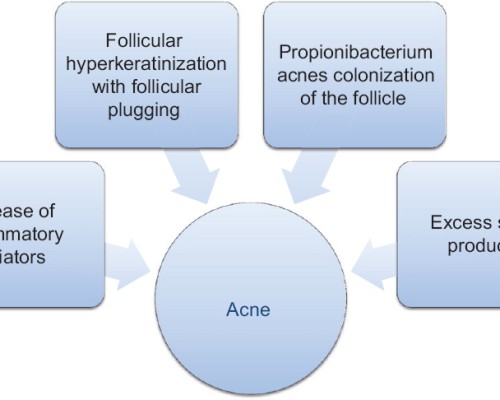
Acne is persistent because it is not caused by a single factor, nor solved by a single ingredient. It is not a condition that can be “fixed” by one product, one lifestyle tweak, or one so-called miracle cure.
Research shows that acne pathogenesis is multifactorial. In plain terms, it has many roots, all interlinked through the interaction of four key biological processes. This is usually described as the “four pillars” of acne and understanding them is essential to managing it effectively.
The Four Pillars of Acne Pathogenesis
1. Altered Sebum Production
Sebum is vital for skin protection. But in acne, its quantity and composition shift.
Sebaceous glands may produce too much oil under the influence of androgens (hormones).
That oil often becomes richer in pro-inflammatory lipids (like squalene peroxides), which irritate the follicle.
Sebaceous glands may produce too much oil under the influence of androgens (hormones).
That oil often becomes richer in pro-inflammatory lipids (like squalene peroxides), which irritate the follicle.
This results in a microenvironment where pores clog more easily and inflammation brews.
2. Follicular Hyperkeratinization
Your skin naturally sheds dead cells daily. In acne, this process malfunctions.
Keratinocytes (skin cells) become “stickier” inside the follicle.
Instead of shedding, they build up, mixing with oil and forming a plug.
This plug becomes the starting point of a comedone (blackhead or whitehead).
Keratinocytes (skin cells) become “stickier” inside the follicle.
Instead of shedding, they build up, mixing with oil and forming a plug.
This plug becomes the starting point of a comedone (blackhead or whitehead).
3. Cutibacterium acnes Ecology
You’ve probably heard of C. acnes. It lives on all our skin, acne or not. The difference is in it’s ecology and balance.
Certain strains of C. acnes are more inflammatory than others.
In acne-prone skin, these strains thrive inside clogged follicles, breaking down sebum and releasing enzymes + metabolites that further irritate the skin.
This shifts the follicle into a pro-inflammatory microenvironment.
Certain strains of C. acnes are more inflammatory than others.
In acne-prone skin, these strains thrive inside clogged follicles, breaking down sebum and releasing enzymes + metabolites that further irritate the skin.
This shifts the follicle into a pro-inflammatory microenvironment.
4. Inflammatory Immune Responses
This is the final and most critical pillar. Acne is not just clogged pores, it’s an inflammatory disease.
Even before a pimple is visible, immune cells are already activated.
Cytokines (inflammatory messengers) flood the follicle.
This inflammation worsens blockage, recruits more immune cells, and creates the redness, swelling, and tenderness we recognise as acne.
Why Is This Important?
Most treatments fail because they target only one pillar. But acne is a network disorder driven by skin barrier function, hormonal signals, microbial balance, and systemic inflammation. A single solution can’t break the cycle.
For example –
- Salicylic acid may clear dead cells (pillar 2) but doesn’t rebalance sebum (pillar 1).
- Benzoyl peroxide targets bacteria (pillar 3), but can worsen barrier damage.
- Retinoids normalise shedding (pillar 2) but don’t always calm inflammation (pillar 4).
That’s why acne often feels like a moving target.
OUR APPROACH
We believe in a barrier-first, multi-pathway approach. Any effective acne care has to:
- Respect and strengthen the skin barrier (so it can regulate itself).
- Use evidence-backed actives in synergy, not isolation.
- Calm the inflammatory cycle while addressing sebum, shedding, and microbiome balance.
Because acne is multifactorial, the solution must be, too.
This is why no single product or ingredient is ever enough, and why a science-led, multi-layered approach is the most effective way forward.
This is why no single product or ingredient is ever enough, and why a science-led, multi-layered approach is the most effective way forward.
Acne is complex, but complexity does not mean chaos. With the right science-led strategies, balance is possible, and sustainable.