

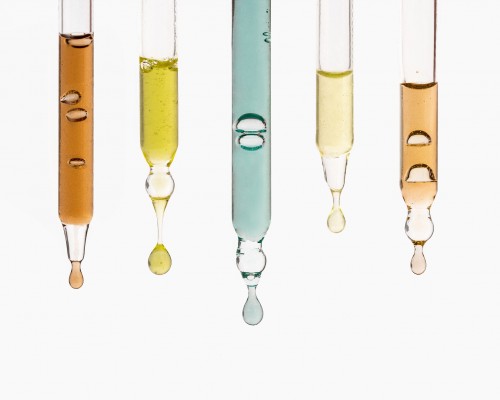
When it comes to vitamin C in skincare, the conversation is too often dominated by percentages. But real science and real results come down to one key factor: bioavailability.
The Problem with L-Ascorbic Acid (L-AA)
L-Ascorbic Acid is the purest and most biologically active form of vitamin C. However, it’s also one of the most chemically unstable ingredients used in skincare.
Here’s why:
- Water-soluble: L-AA is highly reactive in aqueous environments.
- Unstable in air & light: It oxidises quickly when exposed to oxygen, UV light, or heat.
- Low pH dependent: It requires a pH below 3.5 to remain stable and active, which can compromise the skin barrier (if not formulated properly), and cause irritation.
- Oxidation risk: Once oxidised, not only does it lose efficacy, it can also become pro-oxidant, contributing to oxidative stress rather than protecting against it.
High percentages of L-AA often degrade before they reach your skin and can cause inflammation in the process.
The Science of Stability: Enter Derivatives
To address these limitations, stable, molecular modified versions of vitamin C that are designed to be more compatible with topical formulations have been developed.
Some common examples include:
- Magnesium Ascorbyl Phosphate (MAP) – Stable and gentle, but limited skin penetration.
- Sodium Ascorbyl Phosphate (SAP) – Good for acne-prone skin, but slow conversion to active L-AA.
- Ascorbyl Glucoside – Sugar-bound and stable, but less potent.
Each has its pros and cons, but the standout for us is –
3-O-Ethyl Ascorbic Acid: The Ethylated Advantage
At 1611 LABS, we use 3-O-Ethyl Ascorbic Acid, a next-generation vitamin C derivative that offers exceptional stability, penetration, and efficacy.
3-O-Ethyl Ascorbic Acid has a C3 ethyl group attached at the third carbon of the ascorbic acid molecule. This modification inhibits rapid oxidation and makes the molecule more resistant to heat, light, and air.
It is both hydrophilic and lipophilic; meaning it is soluble in both water and oil, allowing for greater formulation flexibility and enhanced skin penetration.
Because of its improved penetration and stability, it is clinically effective at lower concentrations (2–5%) without irritation. Once inside the skin, it’s enzymatically converted into active ascorbic acid, delivering results without compromise.
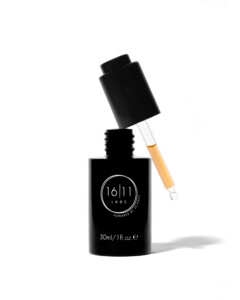
Our VITAMIN C AOX NETWORK is powered by 3-O- Ethyl Ascorbic Acid (EAA), to provide superior anti-oxidative action and effective cellular melanogenesis inhibition.
It’s efficacy is more pronounced than that of Ascorbic Acid.
It’s slower release also means it’s less irritating and provides a slower but more consistent result with continuous use.
We’ve also used a powerful phyto-bioactive specifically developed for it’s high content in lignans, particularly schisandrin plant extracts.
This anti-pollution active protects against all form of urban pollution by activating endogenous skin cellular defence system to fight free radicals, prevent inflammation, strengthen cutaneous barrier, and maintain dermis integrity.
Formulated to be a light water-weight, silky serum for high skin permeability.
This allows for optimal penetration/delivery of molecules through the epidermal skin layer.
A superior antioxidant network designed to PROTECT, REGENERATE & BRIGHTEN.
Designed with a 360 approach to help repair & improve damaged, aged, stressed, and irritated skin. It reverses key signs of photo-damage by protecting the skin, and skin cells from exposure to air pollutants, including polycyclic aromatic hydrocarbons (PAHs), volatile organic compounds (VOCs), oxides, heavy metals, and particulate matter (PM) of all particle sizes.